Introduction
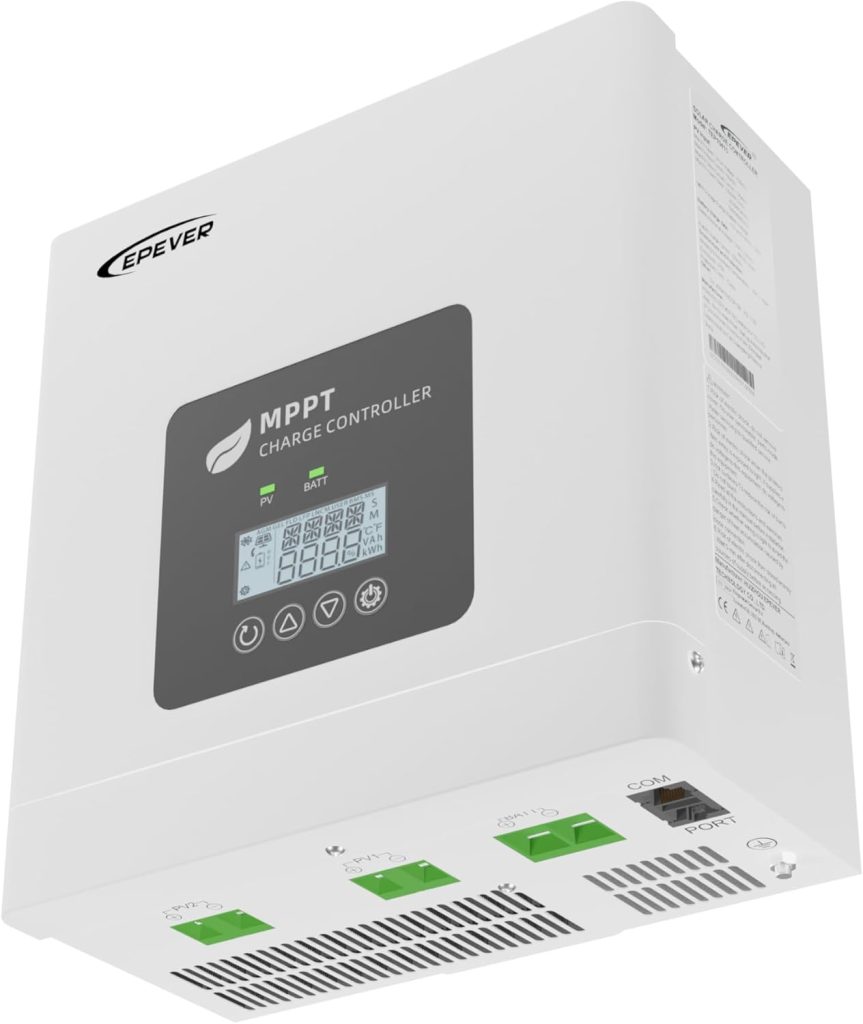
A solar power system is only as strong as its charge controller, the component responsible for regulating the flow of electricity from solar panels to the battery bank. When dealing with high-capacity systems, larger solar arrays, and compatibility with multiple battery types, a powerful controller becomes essential. That is where the SolarEpic EPEVER 100A MPPT Solar Charge Controller excels.
Designed for users who demand high input capacity, flexible wiring options, multi-voltage support, and intelligent charging algorithms, this controller is ideal for home energy systems, off-grid cabins, RVs, boats, and remote powered installations. Offering 100A charge current, 150V maximum PV input, dual PV inputs, and full compatibility with 12V, 24V, and 48V systems, it supports both lead-acid and LiFePO4 lithium batteries.
This in-depth guide explores specifications, performance, benefits, limitations, applications, and best-practice installation recommendations.
What MPPT Technology Means for Your Solar System
A Maximum Power Point Tracking controller, commonly referred to as MPPT, optimizes the power harvested from solar panels by continuously analyzing voltage and current conditions. Instead of directly connecting the panels to the battery bank like older PWM controllers, an MPPT solar charge controller MPPT automatically finds the optimal power point to maximize energy conversion.
This results in:
- Higher charging efficiency
- Improved performance in cloudy or variable weather
- Better compatibility with high-voltage arrays
- Reduced energy loss
The SolarEpic EPEVER 100A MPPT controller uses advanced tracking algorithms with near-instantaneous response, enabling consistent performance even on days with frequent shading or fluctuating sunlight.
Key Features of the SolarEpic EPEVER 100A MPPT Solar Charge Controller
The controller is engineered for high-capacity applications and designed to give system builders flexibility in both wiring and battery types.
Major Features Include:
- 100A charging capacity for large solar arrays
- 150V maximum PV input, suitable for panels wired in long series strings
- Dual PV inputs with multiple wiring modes
- Supports 12V / 24V / 48V systems with auto detection
- Compatible with LiFePO4 and lead-acid batteries
- Parallel capability (up to 6 units) to charge the same battery bank
- High-efficiency MPPT tracking algorithm
- Advanced safety protections for system stability
- Robust internal circuitry for long-term service life
- Negative-grounding design for compatibility with most modern solar systems
- Flexible installation options for off-grid or hybrid solar setups
These features make the controller extremely adaptable, supporting both expansion-ready systems and high-demand energy loads.
Technical Specifications Table
Below is an accurate representation of the technical specifications typically associated with the SolarEpic EPEVER 100A MPPT Solar Charge Controller.
SolarEpic EPEVER 100A MPPT Controller Specifications
| Specification | Detail |
|---|---|
| Rated Charging Current | 100A |
| Maximum PV Open-Circuit Voltage | 150V |
| Dual PV Inputs | Yes, with selectable wiring modes |
| Supported System Voltages | 12V / 24V / 48V (automatic detection) |
| Battery Compatibility | Lead-acid (sealed, gel, flooded), LiFePO4 |
| MPPT Tracking Efficiency | ≥ 99.5% |
| Peak Conversion Efficiency | Up to ~98% |
| Parallel Operation | Supports up to 6 controllers in parallel |
| System Ground | Negative ground |
| Load Control Function | Yes, depending on configuration |
| Protection Systems | Overcharge, over-discharge, over-current, temperature protection, reverse polarity |
| Recommended Applications | Off-grid homes, RVs, boats, cabins, hybrid battery systems |
This combination of high current, high voltage, and dual PV inputs places the controller among the highest-capacity MPPT units suitable for residential and mid-scale solar systems.
Understanding the Dual PV Input Feature
One of the controller’s standout capabilities is its dual PV input system. This allows system designers to choose between:
1. Separate PV Inputs
Each PV input can accept its own array of solar panels. This is ideal for:
- Arrays facing different directions (east/west configurations)
- Installations with variable shading
- Mixed panel types or wattages
2. Combined Wiring Modes
Both PV inputs can be wired together in parallel to maximize current acceptance while still keeping system voltage within safety limits.
This flexibility is particularly useful for optimizing power output while avoiding controller or panel mismatches.
Multi-Voltage System Support
The controller automatically detects the system voltage and adapts to 12V, 24V, or 48V battery banks. This ensures compatibility across a wide range of solar installations.
Benefits of Multi-Voltage Support:
- Freedom to upgrade battery banks later
- Ability to scale power output and reduce system losses
- Greater compatibility with consumer-grade and commercial-grade solar setups
- Enhanced flexibility for RVs, boats, homes, and off-grid property installations
Battery Compatibility and Charging Profiles
The SolarEpic EPEVER 100A MPPT controller supports the two dominant battery classes in modern solar energy systems:
- Lead-acid batteries
- Sealed
- Gel
- Flooded
- AGM
- LiFePO4 lithium batteries
- Automatic recognition available in most configurations
- Stable 2-stage charging
- Safe, high-efficiency lithium activation control
Having support for both battery chemistries makes system upgrades easier and ensures that the user can transition from lead-acid to lithium without needing a new charge controller.
Full Protection Suite
A high-capacity controller requires extensive safety features to maintain system stability. This controller includes:
- PV reverse polarity protection
- Battery reverse polarity protection
- Battery over-voltage protection
- Load over-current protection
- Short-circuit protection
- Over-temperature protection
- PV over-current protection
- Temperature compensation (lead-acid)
These protections reduce the risk of component damage and extend the operational life of both the controller and the battery bank.
Practical Use Cases and Real-World Applications
Thanks to its robust feature set, the SolarEpic EPEVER 100A MPPT controller fits into a variety of real-world energy setups.
1. Off-Grid Homes and Cabins
For homeowners seeking reliable, continuous off-grid energy, the controller supports large solar arrays and battery banks. With up to 150V PV input, long series strings can be used to reduce wire loss.
2. RVs, Camper Vans, and Motorhomes
Mobile users benefit from:
- Lithium compatibility
- Smaller footprint compared to multiple lower-amp units
- Flexibility to use multiple arrays
This controller can manage high-power solar setups suitable for long-term travel.
3. Boating and Marine Applications
Marine systems often require dependable power for refrigeration, pumps, lights, and navigation equipment. The controller’s rugged protections and multi-voltage support make it a trustworthy option for offshore or coastal solar systems.
4. Hybrid Battery Storage Systems
Users running mixed battery banks (e.g., lithium primary with lead-acid backup) benefit from the controller’s customizable charge profiles and voltage flexibility.
5. Remote Work Sites, Agricultural Systems, and Utility Structures
Solar systems for remote farms, well pumps, barns, and construction sites require stable high-power charging. The 100A controller delivers ample current, ensuring smooth operation even under load.
Strengths and Advantages of the EPEVER 100A MPPT Controller
1. High Capacity (100A)
Supports larger solar arrays and bigger battery banks.
2. 150V PV Input
Allows long series strings that reduce wiring losses and simplify installation.
3. Dual PV Inputs
Enhances system design flexibility.
4. Wide Battery Compatibility
Supports both lead-acid and LiFePO4 batteries.
5. Parallel Capability
Up to 6 controllers can be linked in parallel — ideal for large energy systems.
6. High Efficiency
MPPT tracking efficiency above 99.5% ensures excellent solar harvesting.
7. Rugged Safety Architecture
Multiple layers of protection improve reliability and longevity.
Limitations and Considerations
Although the controller offers excellent performance, some limitations must be evaluated:
- Must not exceed 150V PV input
Ensure the solar array’s open-circuit voltage stays under this limit. - Requires proper wire sizing
High current demands thick wiring and proper fusing. - Heat management
The controller must be installed in a ventilated space. - Parallel operation requires careful syncing
When using multiple units, configurations must be consistent.
Installation Guidelines and Best Practices
To maximize safety and performance:
- Always connect the battery first, then the solar panels.
- Verify that the PV array Voc stays below 150V, even in cold weather.
- Use appropriately rated fuses or breakers on both battery and PV sides.
- Ensure cables are thick enough to handle high current.
- Set the correct battery type before charging begins.
- Install indoors or in a covered area with proper airflow.
- Monitor system performance regularly.
- For lithium batteries, ensure a quality Battery Management System (BMS).
Example System Design Using the SolarEpic EPEVER 100A Controller
Example: 48V Off-Grid Cabin System
- Solar Panels: 4000–5000W array
- PV Voltage: Configured below 150V open-circuit
- Battery Bank: 48V LiFePO4, 150–300Ah
- Controller: SolarEpic EPEVER 100A MPPT
- Loads: Lights, fans, appliances via inverter
- Safety: Breakers, fuses, surge protection
- Location: Ventilated utility or power room
This configuration provides a stable power system capable of running essential loads comfortably.
Final Verdict
The SolarEpic EPEVER 100A MPPT Solar Charge Controller is a powerful and capable high-capacity controller suited for mid- to large-scale solar systems. With dual PV input flexibility, 150V maximum PV voltage, multi-battery support, and expandability up to 6 units, it offers the performance needed for off-grid homes, RVs, boats, cabins, and hybrid solar systems.
Its high efficiency, rugged protection features, and large amperage rating make it one of the most reliable options for users who need a long-lasting and future-ready solar controller.