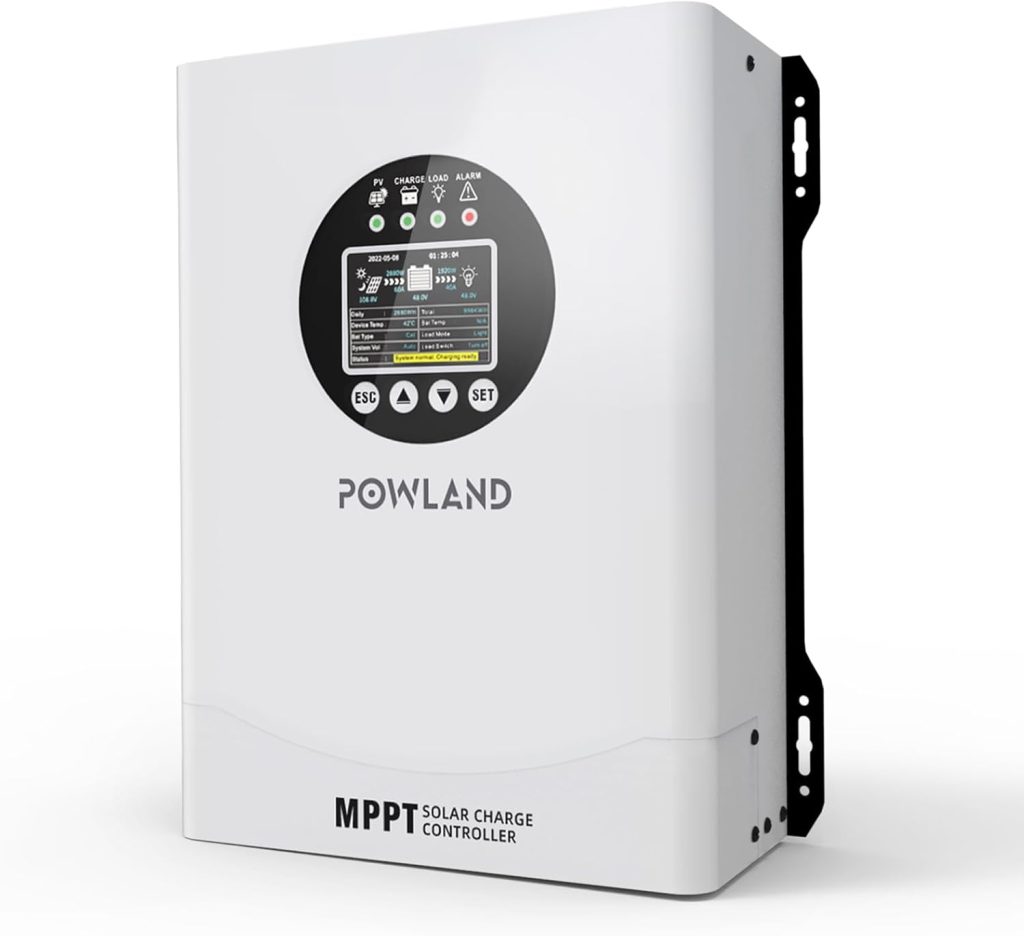
Understanding MPPT Technology and Why It Matters
Before evaluating the product itself, it’s essential to understand the difference between MPPT and traditional PWM controllers.
MPPT vs. PWM: What Makes MPPT Superior?
MPPT (Maximum Power Point Tracking) controllers continuously analyze photovoltaic input to identify the precise voltage and current combination that produces maximum power. This dynamic tracking allows an MPPT controller to convert excess panel voltage into additional charging current.
By comparison, PWM (Pulse Width Modulation) controllers merely connect and disconnect the array to maintain a stable charging voltage. PWM technology is simpler and cheaper but wastes surplus voltage and performs worse in real-world conditions.
Why MPPT Provides Higher Efficiency
- Converts unused voltage into usable charging current
- Adapts to changing environmental conditions
- Especially effective in cold temperatures, cloudy days, and partial shading
- Extracts significantly more total energy from the solar array
Most MPPT controllers achieve efficiencies between 94–98 percent, depending on design. A well-made MPPT controller like the POWLAND 120A can increase harvested energy by up to 30 percent compared to PWM units, especially when the solar array operates at a voltage much higher than the battery bank.
For medium to large solar installations, MPPT is the preferred and often essential technology.
Overview of the POWLAND 120A MPPT Solar Charge Controller
The POWLAND 120A MPPT is designed as a universal, high-power controller capable of supporting a wide range of off-grid and hybrid systems. With its auto-sensing voltage recognition, wide compatibility, and high charging capacity, it is built to serve everything from small RV setups to large off-grid homes.
Below is a detailed summary of its most important capabilities.
Technical Specifications: POWLAND 120A MPPT
| Feature | Specification |
|---|---|
| Controller Type | MPPT (Maximum Power Point Tracking) |
| Battery Voltage Compatibility | Auto-detect: 12V / 24V / 36V / 48V / 60V / 72V / 84V / 96V |
| Maximum Charging Current | 120A |
| Maximum Efficiency | Up to 98 percent |
| Supported Battery Types | AGM, Gel, Flooded Lead-Acid, LiFePO4 Lithium |
| Charging Stages | Bulk, Absorption, Float |
| Protection Features | Reverse polarity, overload, open-circuit, temperature compensation |
| Monitoring Display | LCD screen: PV voltage/current, battery status, charging stage, system warnings |
| Included Accessories | Controller, user manual, battery temperature sensor |
| Applications | RVs, off-grid homes, cabins, mobile power systems, farms, marine solar |
These specifications make the POWLAND 120A suitable for a wide range of system sizes and voltage configurations.
Key Features and Advantages
1. Universal Voltage Compatibility (12V–96V)
One of the standout features of this device is its broad auto-sensing voltage compatibility. Most controllers support only 12V and 24V systems, with mid-range models extending to 48V. The POWLAND 120A supports:
- 12V systems
- 24V systems
- 36V systems
- 48V systems
- 60V systems
- 72V systems
- 84V systems
- 96V systems
This allows the controller to integrate into nearly any solar setup, including high-voltage battery banks used for large off-grid homes or industrial applications.
Why Auto-Sensing Matters
Auto voltage recognition:
- Eliminates configuration errors
- Simplifies installation
- Prevents mismatched battery voltage
- Makes system upgrades easy
Future system expansion becomes significantly more flexible, which is valuable for long-term solar investment.
2. High 120A Charging Capacity
At 120 amps, this controller is built to handle large solar arrays and big battery banks. Systems requiring high continuous current—such as off-grid households, farms, workshops, or commercial installations—benefit from its ability to process large amounts of solar energy.
Estimated Maximum Solar Input Based on Battery Voltage
These are approximate maximum array wattages:
- 12V battery system: up to ~1,700W
- 24V battery system: up to ~3,400W
- 48V battery system: up to ~6,800W
These numbers can vary based on installation design, cable gauge, distance, panel configuration, and environmental conditions.
3. Up to 98% MPPT Efficiency
The controller’s advanced MPPT algorithm provides:
- High conversion efficiency
- Real-time maximum power point tracking
- Faster battery charging
- Reduced energy losses
This efficiency is critical when panel voltage exceeds battery voltage, allowing the controller to convert surplus voltage into usable current.
Performance Advantages in Variable Conditions
The POWLAND 120A MPPT performs especially well in:
- Low-sunlight mornings and evenings
- Cloudy or hazy weather
- Winter temperatures
- Mixed shading conditions
- Multi-panel arrays connected in series
Systems that depend on every watt of available sunlight—such as RVs, boats, or off-grid cabins—see substantial performance improvements compared to PWM controllers.
4. Intelligent Multi-Stage Charging
The controller uses a 3-stage charging process:
- Bulk Charging: Maximum current to quickly charge the battery
- Absorption Charging: Balanced charging to safely reach full capacity
- Float Charging: Maintains full charge without overcharging
This protects battery lifespan and ensures consistent long-term performance.
Battery Compatibility
Supports the most common battery types:
- AGM
- Gel
- Flooded lead-acid
- LiFePO4 lithium
Each chemistry requires unique voltage thresholds and charge profiles. The flexibility to support different batteries increases installation opportunities.
5. Safety and System Protection
The POWLAND 120A MPPT includes:
- Reverse polarity protection
- Overload protection
- Overcurrent protection
- Open-circuit protection
- Temperature compensation
- Over-temperature shutdown
These features protect both the solar array and the battery bank, preventing damage caused by wiring mistakes, excessive current, or environmental extremes.
6. LCD Display with Real-Time Monitoring
The built-in LCD screen provides valuable information, including:
- Solar input voltage
- Solar input current
- Battery voltage
- Battery temperature
- Charging mode
- Charging amperage
- System warnings or diagnostic codes
This allows users to monitor system performance without additional meters or external displays. The included battery temperature sensor improves charge accuracy in hot or cold environments.
7. Installation Kit and Support
The package includes:
- The POWLAND 120A MPPT solar charge controller
- Detailed user manual
- Battery temperature sensor
POWLAND also offers general customer support for installation questions, system configuration, and troubleshooting.
Where the POWLAND 120A MPPT Excels
This controller is ideal for:
- Off-grid homes and cabins
- RV and van conversion solar systems
- Remote farm energy systems
- Marine solar installations
- Hybrid renewable energy setups
- Mobile workshops or construction systems
- Backup solar-powered battery banks
Its high current capacity and wide voltage range make it suitable for both small and large installations.
Potential Considerations and Limitations
Despite its strong capabilities, users should keep the following in mind:
1. Larger systems require careful planning
Higher voltage and higher current systems require:
- Proper wire sizing
- Correct fusing
- Safe battery bank design
- Adequate ventilation during charging
2. MPPT controllers cost more than PWM units
While significantly more efficient, MPPT technology is more expensive.
However, the long-term energy gains usually outweigh the initial cost.
3. System compatibility must be respected
Even with auto-sensing capability:
- Solar input voltage must remain within safe limits
- Panel arrays must be configured to avoid overload
- Battery banks must be in good condition
Following installation guidelines ensures safe and reliable operation.
Conclusion: Is the POWLAND 120A MPPT Worth It?
The POWLAND 120A MPPT Solar Charge Controller is a powerful, efficient, and flexible solution for modern solar systems. Its universal voltage support (12V–96V), high charging capacity, intelligent MPPT algorithm, multi-stage charging process, and wide battery compatibility make it an excellent choice for users who need reliability and performance.
For off-grid homes, large RV setups, remote cabins, workshops, farms, or expandable solar installations, this controller provides:
- High efficiency
- Maximum energy yield
- Broad system compatibility
- Intelligent protection
- Long-term reliability
If you want a controller that is “future-proof” and capable of handling both small and robust solar arrays, the POWLAND 120A MPPT is a strong and dependable option.