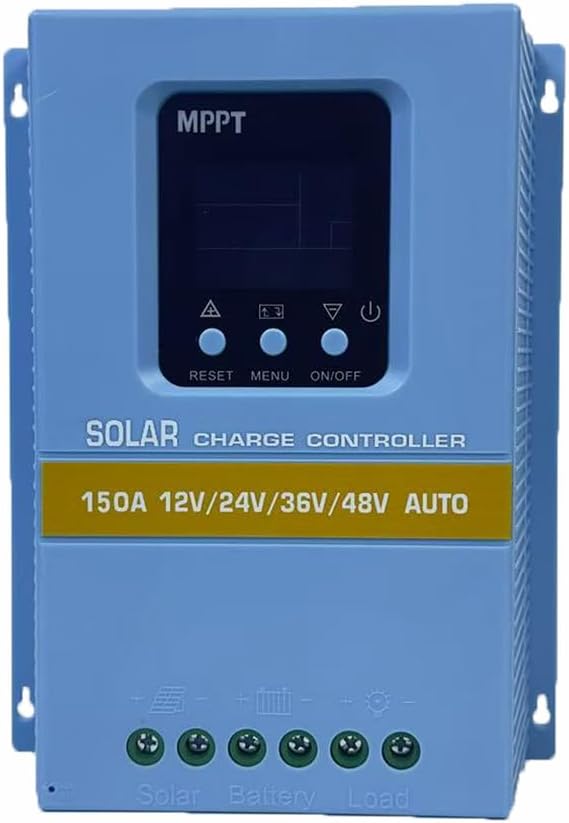
If you are planning a serious solar energy system — whether for a cabin, off-grid house, remote workshop, RV, boat or a large battery bank — the choice of charge controller is crucial. A high-performance controller ensures efficient energy conversion, safe battery charging, long battery life and flexibility for future expansion. The GBEOSMO 150A MPPT Solar Charge Controller is one of the high-capacity controllers available today. In this article, we analyze its features, technical specifications, advantages, real-world applications, and considerations you must keep in mind before choosing it.
What Is an MPPT Solar Charge Controller — Why It Matters
A solar charge controller regulates the energy produced by solar panels before it reaches the batteries. It ensures correct voltage and current, protects from overcharge or under-charge, and extends battery life.
Among charge controllers, there are two main types:
- PWM (Pulse-Width Modulation) controllers — simple and inexpensive, but less efficient.
- MPPT (Maximum Power Point Tracking) controllers — more advanced and much more efficient.
An MPPT charge controller continuously monitors the photovoltaic (PV) panel output (voltage and current) to find the combination that yields maximum power (the “maximum power point”). It then converts surplus voltage into extra current — maximizing the usable energy sent to the battery.
Because panel output often does not match battery needs (especially when panel voltage is much higher than battery voltage), MPPT controllers can significantly increase energy harvest compared to PWM controllers — often 20–30 % more, especially under less-than-ideal lighting or partial shade.
MPPT technology also grants flexibility in system design — higher-voltage solar arrays connected in series, longer wiring runs, and easier expansion — making MPPT controllers ideal for medium or large solar installations.
Given these advantages, for a robust solar setup, choosing a good MPPT controller is nearly always preferable to PWM.
Overview — What the GBEOSMO 150A MPPT Controller Offers
The GBEOSMO 150A MPPT Solar Charge Controller is designed to support large solar installations and heavy-duty battery banks. Its high current capability, wide battery voltage compatibility, intelligent charging algorithms, and built-in protections make it a compelling choice for demanding solar setups.
Here is a breakdown of its main features and claimed capabilities:
Key Features & Capabilities
- High current rating: 150 A charge current — suitable for large solar arrays and sizable battery banks.
- Wide auto-voltage compatibility: Supports 12V, 24V, 36V, 48V and 96V battery systems automatically.
- High input voltage capacity: High maximum input voltage compatible with larger PV arrays (given proper panel configuration).
- Advanced MPPT algorithm: Continuously tracks maximum power point, optimizing energy harvest even under variable sunlight conditions. Claimed photovoltaic utilization rate ≥ 99%, conversion efficiency up to ≥ 98.1%.
- Multi-stage battery charging algorithm: 4-level charging — bulk charging, boost charging, float charging, equalizing charging — enabling faster, safer, more efficient battery charging and longer battery life.
- Compatibility with multiple battery types: Supports a variety of lead-acid batteries: flooded, AGM, GEL, plus lithium-ion (when configured correctly), offering flexibility across many applications.
- LCD display with status monitoring: Built-in LCD screen with control buttons to display current operating data and system status in real time (voltage, current, charging stage, battery status).
- Comprehensive protection suite: Includes short-circuit protection, open-circuit protection, reverse polarity protection, overload protection, and other safeguards to prevent damage and ensure safe operation.
These features make the GBEOSMO 150A controller a powerful option for serious solar energy systems — from residential off-grid homes to large battery bank installations for workshops, remote systems, or renewable energy projects.
Technical Specifications — Data Table
Here is a detailed data table compiling the key specifications typically associated with a 150A MPPT controller like the GBEOSMO 150A (based on typical design patterns for high-capacity MPPT solar controllers). Because user manuals for all variants may vary, always confirm exact values for your unit before installation.
| Specification / Parameter | Value / Description / Range |
|---|---|
| Supported Battery Voltages (Auto-sensing) | 12 V, 24 V, 36 V, 48 V, 96 V (automatic detection) |
| Maximum Charging Current | 150 A |
| MPPT Algorithm Type | Dynamic Maximum Power Point Tracking |
| Claimed PV Utilization Efficiency | ≥ 99% (tracking rate) |
| Maximum Conversion Efficiency | ≈ 98.1% |
| Charging Modes / Stages | 4-level charging: Bulk → Boost → Float → Equalize |
| Battery Types Supported | Flooded lead-acid, AGM, GEL, Lithium-ion (if configured) |
| System Protections | Reverse polarity, overload protection, short-circuit protection, open-circuit protection, over-temperature/over-load protection |
| Display / Monitoring | Built-in LCD + front control buttons, real-time reading of voltage, current, charging stage, battery status |
| Suitable Applications | Off-grid homes, cabins, RVs, boats, remote installations, large battery banks, solar workshops |
| Recommended Panel-Battery Matching | Solar array and battery system must respect controller’s current/voltage rating and safety margins |
Note: Because many 150A MPPT controllers allow high input voltages and large PV arrays, correct design, proper wiring, and proper battery matching are essential to ensure safe and efficient operation.
Advantages — Why Choose the GBEOSMO 150A MPPT Controller
1. High Current Capacity for Large Installations
With a 150 A rating, this controller is appropriate for large battery banks and high-power solar arrays. If you plan a robust off-grid home system, workshop, or remote facility with substantial energy demands — or if you want the flexibility to expand later — the 150A rating gives headroom for growth.
High-amperage capability helps minimize charging times, especially when paired with a suitably large solar array and high-capacity battery bank.
2. Wide Voltage Compatibility and System Flexibility
Support for 12V up to 96V battery systems allows extreme flexibility. Whether your system is a modest 12V setup for a small cabin or a high-voltage/large bank system for a house or industrial application, the controller can adapt. This makes it “future-proof” — ideal if you anticipate scaling your system later.
3. Advanced MPPT Efficiency — Maximize Solar Harvest
Because the controller uses an optimized MPPT algorithm with high conversion efficiency, it can capture more usable energy than simpler controllers — especially under suboptimal sunlight conditions (clouds, partial shade, variable solar angle).
MPPT controllers are widely recognized to increase harvested energy by 20–30% compared to PWM-based units under typical variability, thanks to their dynamic tracking and voltage conversion. GreenLancer+1
This efficiency — combined with the high current capacity — means you can get more usable power out of a given PV array, reduce the number of required panels, or accelerate charging of large battery banks.
4. Multi-Stage Intelligent Charging Extends Battery Life
The 4-level charging algorithm (bulk / boost / float / equalization) provides a more complete and safer charging profile than simpler 2- or 3-stage controllers. This helps maintain battery health over time, prevents over-charging or under-charging, and is particularly useful with lead-acid batteries such as flooded, AGM, or GEL.
Such advanced charging control is essential when your system is critical — for off-grid homes, remote cabins, or installations where battery failure would cause significant disruption.
5. Safety Protections for Reliable Operation
High-current, high-voltage solar systems carry elevated risk. The protection features built into this controller (reverse polarity, short-circuit protection, overload protection, open-circuit protection, over-temperature protection) significantly reduce risk of damage to panels, battery banks, or the controller itself.
Safety features allow for more peace of mind, especially in unattended or remote installations.
6. Broad Battery Compatibility — Flexibility Across Battery Types
Support for flooded lead-acid, AGM, GEL, and lithium-ion batteries allows flexibility depending on what kind of battery bank you intend to build. This is particularly useful if you plan to upgrade from a lead-acid based system to lithium later, or if you want to tailor the system to the battery chemistry you have available.
7. Built-in Monitoring — Real-Time System Oversight
The integrated LCD display and front-panel controls allow you to immediately view system status: input voltage, charging current, battery voltage, charging stage, etc. This helps in installations where remote monitoring devices or complex instrumentation is not available.
Having easy access to real-time data helps detect issues early (overload, incorrect wiring, battery problems) and keeps maintenance simple.
Use Cases — Where the GBEOSMO 150A Controller Shines
This controller is well suited for a variety of scenarios:
- Off-grid homes or cabins — For medium to large households with substantial electricity needs, or future expansion in mind.
- Remote sites / rural installations — For lighting, tools, water pumps, small workshops, or community energy systems where stable solar power is required.
- Large battery banks (lead-acid or lithium) — Especially when battery longevity and safe charging are priorities.
- Hybrid renewable setups — Combining solar with wind or generator backup, where solar is expected to provide significant load support.
- Mobile setups with high demand — Such as larger RVs, boats with substantial power requirements (e.g. refrigeration, navigation, appliances), or off-grid mobile base camps.
- Future-proof systems — If you plan to expand PV panel arrays or battery capacity later, the wide voltage and current support make this controller a good long-term foundation.
Considerations and What to Double-Check Before Installing
While the GBEOSMO 150A MPPT controller offers many advantages, there are important constraints and careful planning requirements to ensure safe and efficient operation:
1. Proper System Sizing and Configuration
Because this is a high-capacity controller, you must ensure that your solar panels, wiring, fuses, and batteries match its capabilities. Overloading the controller (too high current, too high input voltage, insufficient wiring) can lead to system failure or hazards.
Always size cable gauge properly, use appropriate fuses or circuit breakers, and verify that the photovoltaic array’s open-circuit voltage (Voc) and short-circuit current (Isc) remain within the controller’s rated limits under cold/high-irradiance conditions.
2. Matching Battery Type and Charging Profile
If using lead-acid, AGM, GEL, or lithium batteries, ensure the charging parameters (bulk/boost voltage, float voltage, equalization schedule) are correctly set according to battery manufacturer recommendations. Misconfiguration can shorten battery life or damage the battery.
3. Adequate Ventilation and Temperature Considerations
High-power MPPT controllers can heat up under continuous load. Proper ventilation, mounting, and avoidance of high ambient temperature beyond rated conditions are important for safety and longevity.
4. Higher Cost and Complexity Compared to Simple PWM Controllers
As with all MPPT controllers — especially high-current ones — the cost is higher, and installation requires more technical knowledge (wiring, matching, configuration) than simple PWM systems. For very small or low-power installations, such complexity and expense may not be justified. smartbuy.alibaba.com+1
5. Overspecification Risk for Small Systems
If your system is small (low wattage panels, small battery bank, limited load), a 150A controller may be overkill. Over-specifying can result in unnecessary expense and complexity. In such cases, a smaller MPPT controller or even a PWM controller might suffice.
Why MPPT Controllers (Like This GBEOSMO) Are Generally Superior to PWM or Simple Regulators
- Higher efficiency and more energy harvested: MPPT controllers convert excess panel voltage into usable current, especially when panel voltage is higher than battery voltage, or under changing sunlight—yielding 20–30 % more energy than PWM controllers.
- Better performance under variable conditions: In cloudy weather, early morning or late afternoon light, or partial shade, MPPT controllers continue to optimize power output, while PWM performance suffers.
- Flexibility in PV array and system design: You can use higher-voltage panel arrays (wired in series), reduce wiring losses over long distances, and accommodate larger battery banks — giving design freedom and expansion potential.
- Faster charging and better battery health: With intelligent multi-stage charging and correct profiles, MPPT controllers charge batteries more efficiently and safely, extending battery lifespan — especially in systems with heavy battery use.
- Reduced hardware costs over time: Because you get more usable energy per watt of panel, you may need fewer panels or smaller inverters — decreasing total system cost. Over time, the higher initial cost of an MPPT controller often pays off via energy gains and battery longevity.
For these reasons, MPPT controllers such as the GBEOSMO 150A represent an excellent investment when building a serious solar installation.
Final Thoughts — Is the GBEOSMO 150A MPPT Solar Charge Controller Right for You?
If you are setting up a medium to large solar power system, with substantial battery capacity, multiple loads, or desire for system expansion, the GBEOSMO 150A MPPT Solar Charge Controller is a strong candidate. Its high current rating, wide auto-voltage compatibility, advanced MPPT algorithm, multi-stage charging, battery compatibility, and safety protections deliver a high level of performance and flexibility.
This controller matches well with off-grid homes, remote installations, large battery banks, hybrid systems, and future-upgrade oriented solar setups. Its power handling and versatility make it “future-proof” for users who anticipate growth or heavy energy demand.
However, if your system is small (just a few panels or low wattage), or if you prefer simplicity and minimal cost, a less powerful controller may suffice. For small-scale or basic solar installations, over-specifying can lead to unnecessary cost and complexity.
In most cases where reliability, efficiency, and capacity matter — especially under variable weather, large use or planned expansion — choosing a high-capacity MPPT controller like the GBEOSMO 150A is an investment that pays off.
If you like, I can build a comparison table showing 3–5 high-capacity MPPT controllers (similar to or higher than 150A), including approximate performance, pros/cons, and suitability for different types of solar systems. That can help you choose the best fit for your project. Do you want me to create that comparison now?