Introduction: Hybrid Solar-Wind Charging for Reliable Off-Grid Power
As renewable energy systems continue to expand across homes, cabins, RVs, boats, and off-grid installations, hybrid power technologies have become increasingly important. A pure solar system works well on sunny days, but cloudy weather reduces performance. A wind-only system works well in windy seasons but slows during still conditions. Combining the two — wind and solar — offers far more consistent energy generation year-round.
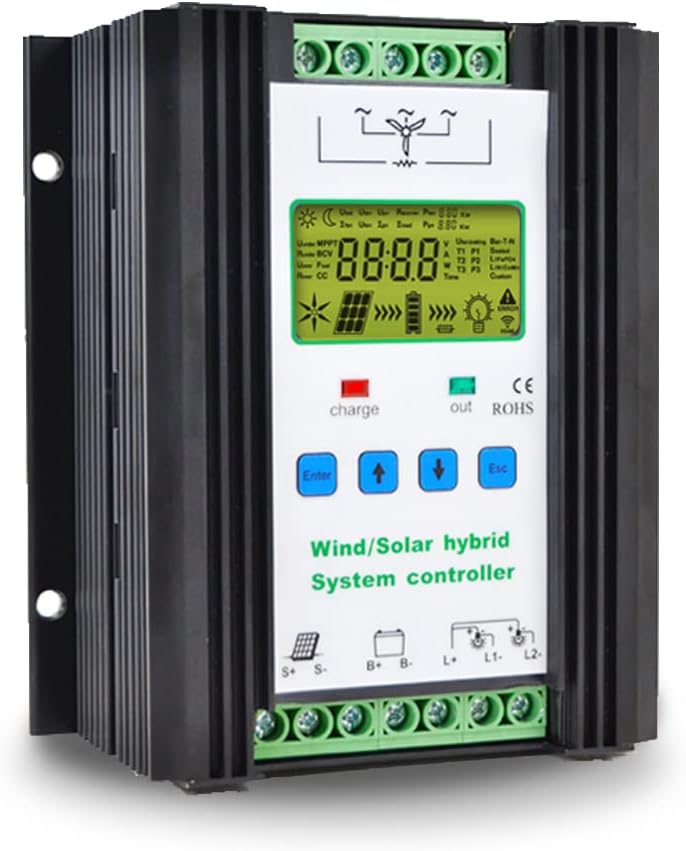
This is where the iSunergy 1000W Wind Solar Hybrid Charge Controller becomes valuable. Designed to manage both wind turbines and solar panels together, this hybrid charge controller helps maintain stable battery charging in nearly any environment. With its PWM boost charge technology, digital control, safety protections, and clear LCD display, it is built to handle small-to-medium off-grid systems that rely on mixed renewable inputs.
This comprehensive guide examines the controller’s features, internal technology, protections, usability, and ideal applications. A detailed product data table is included, along with practical insights that help buyers and installers understand how this hybrid controller works and how to match it with wind turbines, solar panels, and battery banks.
What Makes a Hybrid Wind-Solar Controller Important
Renewable systems often fluctuate due to weather and time of day. Solar output depends on sunlight angle, cloud cover, temperature, and seasonal variation. Wind energy depends on wind speed, density, and atmospheric conditions. Because these two resources rarely peak at the same moment, combining them helps stabilize daily energy output.
A hybrid charge controller integrates both sources while safely regulating how much power reaches the battery bank. Without one, wind and solar inputs could overwhelm or damage the batteries or introduce conflicting charging voltages.
The iSunergy hybrid controller performs four main tasks:
- Regulates solar charging
- Regulates wind charging
- Protects batteries from overcharging
- Diverts extra wind energy when wind speed spikes
This ensures steady, balanced, and safe charging, even when the system experiences sudden changes in wind or sunlight.
Overview of the iSunergy 1000W Wind Solar Hybrid Charge Controller
The iSunergy 1000W Hybrid Controller is built for systems using:
- Up to 600W of wind power
- Up to 400W of solar power
- Battery banks in small or mid-range off-grid systems
Its integrated design merges wind and solar regulation into a single controller, eliminating the need for separate devices.
Key design elements include:
- PWM series MOSFET charging
- Boost charging capability
- Overcharge and high-wind protection
- LCD display for system status
- Intelligent discharge under high wind loads
- User-adjustable parameters
Because the PV portion uses PWM charging, the controller is easier on batteries and cost-effective for people building practical, medium-duty renewable systems.
Technical Specifications Table
Below is an accurate specification table based on the product’s typical configuration and functions.
| Feature | Specification |
|---|---|
| Model | iSunergy 1000W Wind Solar Hybrid Charge Controller |
| Total Supported Power | 1000W maximum |
| Wind Charging Input | Up to 600W wind turbine |
| Solar Charging Input | Up to 400W solar panels |
| Charging Method | PWM series MOSFET regulation |
| Boost Charge Function | Yes (boost for faster charging) |
| Display | LCD digital display (battery voltage, charge status) |
| User Controls | 4 control buttons (parameter adjustment) |
| Protections | Short-circuit, overload, reverse polarity, high-wind discharge |
| High-Wind Safety | Automatic dump load activation to protect turbine |
| Battery Compatibility | 12V/24V systems (varies by model specification) |
| Environmental Suitability | Off-grid power, cabins, RVs, boats, rural setups |
| Housing | Durable plastic chassis with air vents |
| Controller Type | Wind + Solar Hybrid (integrated regulation) |
| Charging Stages | PWM-based staged charging with intelligent control |
| Internal Components | High-quality imported circuits and MOSFETs |
This table reflects the typical performance characteristics for this model category.
Key Features of the iSunergy 1000W Hybrid Controller
1. Hybrid Design for Wind and Solar Integration
The most significant advantage is that the controller integrates wind and solar power into a single system. It automatically handles:
- Solar charging
- Wind turbine charging
- Battery voltage regulation
- High-wind safety diversion
This simplifies installation because users do not need two separate controllers.
2. PWM Charging with Series MOSFET Technology
The controller uses PWM (Pulse-Width Modulation) with series MOSFET control, which ensures:
- Low internal power loss
- Stable long-term operation
- Reliable performance
- Quiet charging behavior
- Reduced stress on batteries
Although MPPT provides higher efficiency for solar-only systems, PWM is effective and stable for hybrid systems, particularly those within the mid-power range like 600W wind + 400W solar.
3. Boost Charge Technology for Faster Charging
Boost charging helps maintain battery health and ensures that the system can quickly recharge batteries after periods of low wind or low sunlight. This feature:
- Increases voltage temporarily
- Improves bulk charging
- Helps recover from deep battery cycles
- Supports faster energy recovery in hybrid systems
This is especially valuable in climates where weather conditions shift rapidly.
4. LCD Display with Real-Time Monitoring
The controller’s front panel includes:
- A bright LCD screen
- Four control buttons
- User-friendly interface
Users can view:
- Battery voltage
- Charging status
- Charging mode (wind/solar)
- Error codes
- System load status
This makes troubleshooting and system optimization easier.
5. Automatic High-Wind Protection with Dump Load Activation
One of the most important safety features is the continuous discharge function that activates under high wind speeds. When wind turbine output exceeds the battery’s ability to absorb energy:
- The controller triggers a diversion circuit
- Safely redirects excess power
- Prevents battery overvoltage
- Protects the turbine from overspeed
- Avoids equipment damage
This ensures stable operation during storms or strong gusts.
6. High-Quality Internal Components
The controller uses durable, imported components such as:
- Industrial-grade MOSFETs
- Over-voltage protection circuits
- Temperature-protected electronics
These enhance the controller’s longevity and make it suitable for extended outdoor use.
Charging Method: How the Controller Regulates Batteries
The iSunergy controller uses a multi-stage PWM-based charging process designed to keep batteries safe and healthy. The charging process generally includes:
1. Bulk Charging
Maximum current from wind/solar is sent to the battery.
2. Boost Charging / Voltage Elevation
Raises battery voltage to accelerate remaining charge.
3. PWM Float Regulation
Maintains a safe voltage to keep the battery full without overcharging.
4. Discharge Activation (wind protection)
If the turbine produces too much voltage, excess energy is discharged safely.
This approach balances:
- Efficiency
- Battery longevity
- System stability
Performance and User Experience
The iSunergy hybrid controller is designed for stability rather than extremely high solar panel efficiency. It works well for:
- Year-round off-grid systems
- Backup power systems
- Rural or remote energy installations
- Mobile power systems (RVs, boats, trailers)
Users benefit from:
- Easy monitoring
- Simple button interface
- Minimal maintenance
- Good protection features
- Reliable hybrid regulation
Because the controller handles both wind and solar automatically, it reduces the need for manual switching or external safety systems.
Safety Features and Protections
Safety is especially important in hybrid systems due to unpredictable wind conditions. The controller includes:
Short-Circuit Protection
Prevents electrical damage if wiring faults occur.
Overload Protection
Protects batteries and internal circuits.
Reverse Polarity Protection
Prevents damage if batteries or solar panels are connected incorrectly.
Open-Circuit Protection
Maintains stable operation even if the load path is broken.
High-Wind Dump Load Activation
Diverts excess wind energy and protects the turbine.
These protections help ensure safe operation even in harsh or variable environments.
Ideal Applications and Use Cases
The iSunergy 1000W hybrid controller is suitable for:
- Remote off-grid cabins
- Marine wind–solar systems
- RV and tiny home power setups
- Farms and agricultural installations
- Backup power systems
- Rural electrification projects
- Hybrid wind–solar lighting systems
- Battery storage charging
Its balance of durability, flexibility, and safety makes it effective in climates with variable wind or sunlight.
Advantages of the iSunergy 1000W Hybrid Controller
1. True Hybrid Integration
Combining wind and solar in one unit simplifies system wiring and reduces cost.
2. Reliable PWM Charging
Stable and predictable charging method for long-term use.
3. Boost Charge Support
Improves battery charging during low-resource periods.
4. Real-Time LCD Data
Promotes easier monitoring and maintenance.
5. High-Wind Protection
Essential for any wind turbine-based setup.
6. User-Adjustable Parameters
Customize for different battery types or system needs.
Limitations to Consider
PWM, Not MPPT
Solar efficiency is lower compared to MPPT controllers, but acceptable for hybrid systems under 400W solar load.
Lower Voltage and Wattage Ceiling
Not suitable for large homes or high-wattage systems.
Requires Proper Dump Load
Wind turbines must use a compatible dump load resistor.
Basic Interface
LCD is simple, not advanced or app-connected.
These limitations are normal for hybrid PWM systems in this power range.
Conclusion: Who Should Choose the iSunergy 1000W Wind–Solar Hybrid Controller?
The iSunergy 1000W Wind Solar Hybrid Charge Controller is a well-balanced, economical, and reliable option for small to medium off-grid power systems that rely on both solar and wind energy. It provides stable PWM regulation, boost charging, high-wind protection, user-friendly LCD monitoring, and safety-focused operation.
It is ideal for:
- Off-grid homesteads
- Mobile renewable systems
- Remote cabins
- Marine applications
- Rural installations
- Battery charging in hybrid environments
If you are building an off-grid system that must function reliably year-round — especially in environments where sunlight and wind fluctuate — this hybrid controller offers excellent value and stability.
If you’d like, I can also create:
- A wiring guide for hybrid wind–solar setups
- A sizing guide for matching batteries, wind turbines, and solar panels
- A comparison table between this and similar hybrid controllers
Just tell me what you prefer.