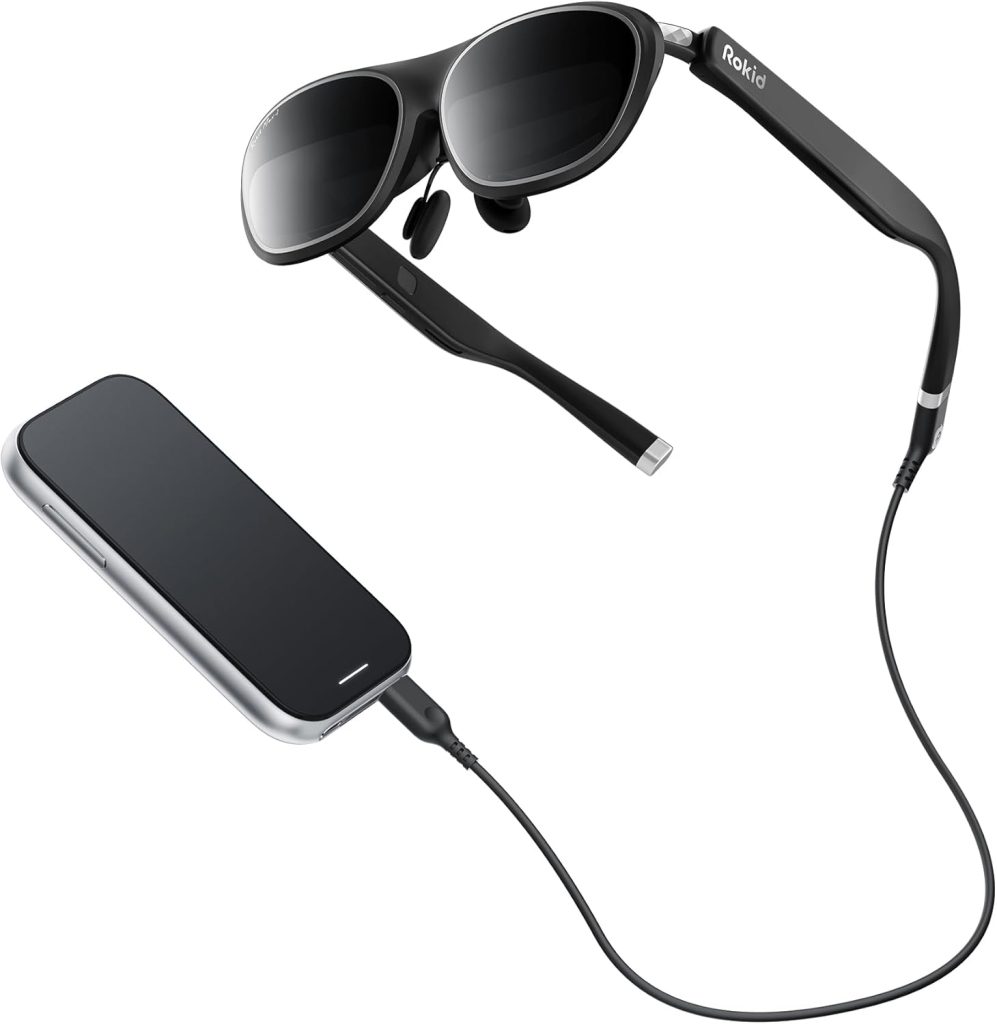
A powerful spatial computing system for immersive work and play
Augmented reality glasses are evolving beyond simple personal displays into full spatial computing platforms. The Rokid AR Spatial Video Glasses system represents this next step by combining advanced AR eyewear with a dedicated spatial computer, enabling multitasking, immersive gaming, and cinematic entertainment in a portable form.
Developed by Rokid, a company known for pushing innovation in AR and AI hardware, this system pairs the lightweight Rokid Max2 AR Glasses with the Station2 Spatial Computer. Together, they deliver a unique 3-screen display environment, powerful onboard processing, and flexible interaction methods designed for both productivity and entertainment.
This in-depth review explores the full Rokid AR Spatial ecosystem, covering hardware design, display performance, multitasking capabilities, comfort, controls, and real-world use cases.
Product Overview
The Rokid AR Spatial Video Glasses system is not just a pair of AR glasses. It is a complete spatial computing solution that includes:
- Rokid Max2 Black AR Glasses
- Station2 Spatial Computer
- YodaOS-Master operating system
This combination allows users to run apps independently of a phone or PC, view multiple virtual screens at once, and interact with content using gestures, voice commands, touch controls, or external peripherals.
Rather than focusing solely on media consumption, the Rokid AR Spatial system is designed to handle multitasking workflows, immersive gaming, and spatial video experiences in a compact, wearable setup.
Technical Specifications Table
| Feature | Specification |
|---|---|
| Brand | Rokid |
| AR Glasses Model | Max2 Black |
| Operating System | YodaOS-Master |
| Storage Capacity | 128 GB |
| RAM | 8 GB |
| Special Feature | 3-screen multitasking |
| Display Technology | Micro-OLED |
| Resolution | 1920 × 1200 per screen |
| Refresh Rate | 120 Hz |
| Brightness | 600 nits |
| Color Gamut | 108% sRGB |
| Degrees of Freedom | 3DoF / 0DoF |
| Myopia Adjustment | Up to 600° |
| IPD Adjustment | 55–72 mm (with Station2) |
| Battery Capacity | 5000 mAh |
| Battery Runtime | Approx. 3.5 hours |
| Connectivity | Wi-Fi 6, Bluetooth 5.2 |
| Weight (Glasses) | 75 g |
| Weight (Station2) | 0.31 kg |
| Wireless Standards | 802.11ax, Bluetooth |
| GPS | No GPS |
Display Technology and Visual Experience
Advanced Micro-OLED Panels
At the core of the Rokid AR Spatial system are its Micro-OLED displays. Compared to earlier generations, the Max2 AR Glasses feature a 50% larger display area, delivering sharper visuals and improved immersion. The 1920 × 1200 resolution per eye ensures crisp text, detailed graphics, and reduced screen-door effects.
The 120Hz refresh rate contributes to smooth motion, which is especially noticeable during gaming, fast-moving video, and interface navigation. Combined with 600 nits of brightness, the visuals remain clear and vibrant across a range of lighting conditions.
Cinematic Color Accuracy
With 108% sRGB color coverage, the display produces rich, accurate colors suitable for movies, games, and creative content. Contrast levels are well balanced, allowing dark scenes to retain detail without crushing blacks, while bright scenes remain comfortable to view for extended sessions.
3-Screen Multitasking Capability
True Multi-Screen AR Environment
One of the most distinctive features of the Rokid AR Spatial Video Glasses is the 3-screen display mode. This setup allows users to run three applications simultaneously, each on its own virtual screen. The screens can be positioned side by side, enabling efficient multitasking without the need for physical monitors.
This feature is particularly useful for:
- Productivity workflows such as browsing, messaging, and document viewing
- Gaming with reference content or chat windows
- Media consumption alongside social or informational apps
It is important to note that when connecting directly to Android phones, the 3-screen mode is supported only via DLNA, while Miracast and Chromecast are limited to single-screen operation.
Smart Viewing Modes and Aspect Ratios
Four Intelligent Display Modes
The system includes four primary smart modes, each tailored to different use cases:
- Reading Mode
- Giant Screen Mode
- Sports Mode
- Multi-Screen Mode
Each mode adjusts screen behavior and interaction style to optimize the viewing experience.
Flexible Screen Sizes and Ratios
Users can choose from Wide (16:9), Narrow (3:4), or Ultra-Wide (21:9) aspect ratios, depending on the content and app support. In Giant Screen Mode, the display can expand up to a dramatic 32:9 ratio, creating a highly immersive cinematic environment ideal for movies and videos.
3DoF and 0DoF Spatial Tracking
Understanding Degrees of Freedom
The Rokid AR Spatial system supports both 3DoF and 0DoF modes:
- 3DoF allows the screen to remain fixed in space as the user moves their head
- 0DoF causes the screen to follow head movement
Giant Screen Mode and Multi-Screen Mode support 3DoF, which is ideal for productivity and immersive viewing. Sports Mode and Reading Mode use 0DoF, providing a stable, head-following display suitable for casual use.
This flexibility allows the glasses to adapt to different environments and tasks.
Myopia and IPD Adjustments
Built-In Vision Correction
The Max2 AR Glasses support myopia adjustment up to 600 degrees, allowing many users to achieve clear visuals without wearing prescription glasses. Adjustment dials located on the top of the glasses make fine-tuning quick and intuitive.
Astigmatism is not supported, and users with stronger prescriptions may require separate corrective lenses.
Automatic IPD Adjustment
When paired with the Station2 Spatial Computer, the system offers automatic interpupillary distance adjustment ranging from 55 to 72 mm. This feature enhances comfort and visual clarity by ensuring proper alignment of the displays with the user’s eyes.
Station2 Spatial Computer Performance
Dedicated Processing Power
The Station2 Spatial Computer acts as the brain of the system. Equipped with 8 GB of RAM and 128 GB of internal storage, it can run multiple applications smoothly without relying on a smartphone or PC.
The YodaOS-Master operating system is optimized for spatial interaction, offering a user interface designed specifically for AR environments.
Battery Life and Portability
The built-in 5000 mAh battery provides approximately 3.5 hours of runtime, depending on usage. Dual USB-C ports allow users to charge the device while using it, ensuring uninterrupted sessions during longer use.
Despite its capabilities, the Station2 remains compact and portable, weighing just 0.31 kg.
Controls and Interaction Methods
Multiple Input Options
The Rokid AR Spatial system supports a wide range of control methods:
- Gesture-based spatial rays
- Voice commands
- Touch controls
- External gamepads and keyboards via Bluetooth or USB
This versatility allows users to choose the most comfortable interaction style for their needs, whether navigating menus, gaming, or working.
Comfort and Ergonomic Design
Lightweight AR Glasses
Weighing only 75 grams, the Rokid Max2 AR Glasses are designed for extended wear. The lightweight frame reduces pressure on the nose and ears, making long sessions more comfortable.
Improved Nose Pad Design
The redesigned nose pad features an airy cushioning structure that improves airflow and reduces pressure fatigue. This design also helps prevent slippage, maintaining a stable fit during movement. Multiple spare sizes are included to accommodate different face shapes.
Entertainment and Gaming Ecosystem
Exclusive Rokid App Store
Through the Station2 app store, users gain access to popular streaming platforms and 3D games. While some apps support full spatial interaction, certain services operate in 0DoF mode due to content restrictions.
Console and Device Compatibility
The system can connect to gaming consoles such as Nintendo Switch, PlayStation 5, and Xbox, providing a large virtual display for immersive gameplay without noticeable lag.
Spatial Album and Content Sharing
The Spatial Album feature allows users to relive memories in 3D using compatible smartphones. Content can be transferred quickly between devices via the Rokid AR app, making it easy to share videos and photos across the ecosystem.
Advantages and Limitations
Key Advantages
- True 3-screen multitasking in AR
- High-resolution Micro-OLED displays with 120Hz refresh rate
- Dedicated spatial computer with onboard storage
- Flexible 3DoF and 0DoF modes
- Lightweight and comfortable design
- Broad control options and device compatibility
Considerations
- Limited battery runtime without external power
- Astigmatism not supported
- Some apps restricted to 0DoF mode
Final Verdict
The Rokid AR Spatial Video Glasses system stands out as a comprehensive spatial computing solution rather than a simple pair of AR glasses. By combining high-quality Micro-OLED displays, a powerful spatial computer, and true multi-screen multitasking, it delivers an experience that bridges productivity and entertainment.
For users seeking an advanced AR setup capable of handling gaming, multitasking, and immersive media in a portable form, the Rokid AR Spatial system offers a compelling and forward-looking solution.