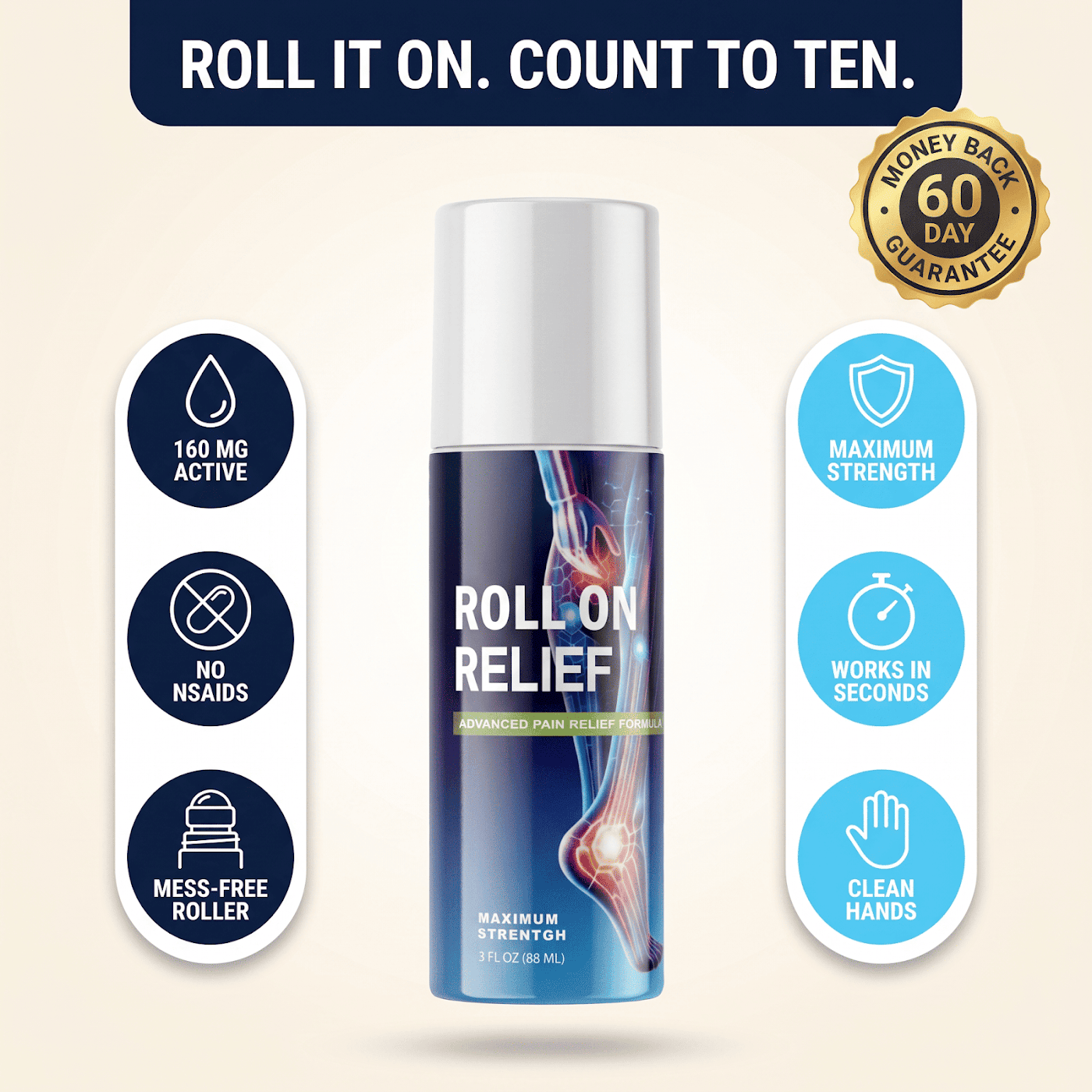
Finding a topical pain reliever that is easy to apply can be useful when sore muscles, aching joints, or back discomfort make everyday activities less comfortable. Roll On Relief uses a rolling-ball applicator instead of requiring you to spread a cream or ointment with your fingers, giving the product a different approach to topical pain relief.
Roll On Relief is marketed as a maximum-strength topical analgesic containing camphor, menthol, and peppermint oil as its active ingredients. This review examines the formula, applicator, intended uses, directions, safety warnings, pricing, and the situations in which the product may make sense for someone looking for a topical pain-relief option.
One of the product’s most noticeable features is the applicator. The four-inch bottle is designed to make applying the formula to hard-to-reach areas easier, particularly around the back. For someone who prefers not to put topical pain-relief products directly on their hands, that design can be a practical advantage.
What Is Roll On Relief?
Roll On Relief is a 3-fluid-ounce topical analgesic intended for temporary relief of aches and pains in the muscles and joints. According to the product’s Drug Facts information, its labeled uses include discomfort associated with arthritis, backache, strains, and sprains.
The formula contains three active ingredients: camphor, menthol, and peppermint oil. The product lists 80 mg of camphor, 50 mg of menthol, and 30 mg of peppermint oil, for a combined 160 mg of active ingredients.
Unlike an oral pain reliever, Roll On Relief is intended for external use and is applied directly to the affected area with the rolling-ball applicator.
A topical format may appeal to people who prefer applying a product directly to an area of discomfort. Even so, the product has specific directions and warnings involving damaged skin, heat, application frequency, and accidental ingestion that should be followed carefully.
Roll On Relief Ingredients
The product clearly identifies its active ingredients, making it easier to see what provides its topical analgesic effect instead of relying only on general strength claims.
| Ingredient | Amount | Role |
|---|---|---|
| Camphor | 80 mg | Active topical analgesic |
| Menthol | 50 mg | Active topical analgesic |
| Peppermint oil | 30 mg | Active topical analgesic |
| Aloe vera gel | 380 mg | Other ingredient |
| MCT oil | 10 mg | Other ingredient |
| Tea tree oil | 5 mg | Other ingredient |
| Sunflower lecithin | 1.5 mg | Other ingredient |
| DMSO | 1 mg | Other ingredient |
| Arnica | 0.1–0.5 mg | Other ingredient |
| Turmeric curcumin | 0.1–0.5 mg | Other ingredient |
| Ginger oil | 0.1–0.5 mg | Other ingredient |
| Total active ingredients | 160 mg | External analgesic |
Listing the individual amounts makes the formula easier to evaluate because the three active ingredients are shown separately rather than hidden inside a proprietary blend. For shoppers comparing topical analgesics, that gives them more information to work with.
The ingredient list should not be treated as proof that every ingredient provides a specific medical benefit beyond the product’s labeled uses. The active ingredients and their amounts are the most relevant information when evaluating the product as a topical analgesic.
How Does Roll On Relief Work?
The product works as a topical analgesic that is applied directly to the skin over the area of discomfort. Its active formula contains camphor, menthol, and peppermint oil, while the rolling-ball applicator is designed to make targeted application easier.
The rolling-ball applicator is one of its most practical features. Rather than squeezing a cream onto your hand and then rubbing it into the skin, you roll the applicator across the area where the product is intended to be used.
The applicator can reduce direct contact between your hands and the formula during application. That can be convenient when using the product on your back, shoulder, knee, or another difficult-to-reach area.
The applicator can also make application less messy than using a traditional cream or ointment. Instead of putting the product on your fingers first, you can apply it directly to the intended area.
The longer bottle is also designed to make hard-to-reach areas easier to access. That is particularly useful for back discomfort, which is one of the product’s labeled uses.
Roll On Relief Benefits
One of the main advantages of Roll On Relief is the combination of a topical analgesic formula and a rolling-ball applicator.
Less Direct Hand Contact
The rolling-ball design means you can apply the product without spreading it across the skin with your fingers. This can be useful for people who prefer a cleaner application.
Easier Access to the Back
The longer bottle and rolling-ball applicator are designed to make application to the back easier. This is particularly relevant for users who live alone or simply prefer to apply a topical product without assistance.
Clearly Listed Active Ingredients
The product clearly lists its three active ingredients rather than hiding them behind a proprietary blend. That gives buyers a straightforward way to see what the topical analgesic contains before deciding whether it fits their preferences.
No Oral Administration
The product is intended for external use, making it an option for consumers who prefer a topical format rather than an oral pain-relief product.
No Subscription Requirement
The purchase options described by the product site are presented as one-time purchases rather than an automatically renewing subscription. That can be useful for buyers who do not want recurring charges.
Several Labeled Uses
The labeled uses include temporary relief of aches and pains of muscles and joints associated with arthritis, backache, strains, and sprains. That makes the product relevant to several common types of occasional muscle and joint discomfort.
How to Use Roll On Relief
The product’s directions state that adults and children over 12 years old should apply it to the affected area no more than four times daily.
Apply the product only as directed on the label. Do not use it as a general skin-care product or apply it more frequently than recommended.
The basic directions are:
- Apply to the affected area as directed.
- Do not use more than four times daily.
- Adults and children over 12 years old should follow the labeled directions.
- Children 12 years old or younger should consult a doctor before use.
It is important not to assume that applying more product will produce better results. The labeled frequency is there for a reason, and users should follow the instructions on the product rather than increasing application frequency on their own.
The product’s warning information says to stop use and ask a doctor if symptoms become worse or continue for more than seven days.
Where Can Roll On Relief Be Useful?
The product is labeled for temporary relief of aches and pains involving muscles and joints associated with several common situations.
Backache
The roll-on format may be particularly useful for back discomfort because the bottle is designed to make the area easier to reach without asking someone else to apply the product.
Muscle Soreness
A topical analgesic may be convenient when discomfort is concentrated in a particular muscle area. The roll-on allows the product to be applied directly where it is needed.
Strains and Sprains
Strains and sprains are among the conditions listed in the product’s Drug Facts information. However, significant injuries can require medical evaluation, particularly when pain is severe, swelling is substantial, movement is restricted, or symptoms are not improving.
Joint Discomfort
The product is also labeled for temporary relief of aches and pains of joints associated with arthritis. It should be used according to its label rather than as a replacement for medical treatment prescribed for an underlying condition.
Roll On Relief Safety and Warnings
Before using Roll On Relief, it is important to understand the product’s directions and warnings, particularly because it contains active topical analgesic ingredients.
The product is intended for external use only. It should not be swallowed and should not be applied to wounds or damaged skin.
Avoid contact with the eyes and mucous membranes. If accidental contact occurs, follow the product’s safety instructions and seek appropriate medical advice if needed.
The product also states that it should not be used together with other ointments, creams, or sprays. Combining topical products can increase the chance of unwanted skin reactions or unintended exposure to active ingredients.
Do not use Roll On Relief with a heating pad or other heating device.
This warning is particularly relevant for people who commonly use heating pads for back or muscle discomfort. The product specifically says not to combine it with a heating pad or other heating device.
The product states that users should wash their hands with cool water after each use. Although the rolling-ball applicator helps reduce direct contact, hand washing remains part of the labeled safety instructions.
The product should also be kept out of reach of children. If it is accidentally swallowed, the product information says to get medical help or contact Poison Control immediately at 1-800-222-1222.
There is also a flammability warning. The product should be kept away from excessive heat and open flames and stored in a cool, dry place with the lid closed tightly.
The product should not be used if the full body safety seal is broken or missing.
Who Should Be Careful With Roll On Relief?
Certain people should review the product’s warnings particularly carefully before using it.
People who are pregnant or breastfeeding are instructed by the product labeling to ask a health professional before use.
The age restrictions are also important. Adults and children over 12 years old should follow the labeled directions, while children 12 years old or younger should consult a doctor before use.
Anyone with damaged skin, open wounds, or irritation in the intended application area should not apply the product to that area.
It is also important to distinguish temporary symptom relief from treatment of an underlying medical problem. A topical analgesic may help with temporary aches and pains, but persistent or worsening symptoms can indicate that a healthcare professional should evaluate the condition.
Roll On Relief vs. Traditional Topical Creams
The biggest difference between Roll On Relief and a traditional topical cream is the application method.
A cream generally requires the user to squeeze out a portion and rub it into the skin. With a roll-on, the applicator itself makes contact with the intended area.
| Feature | Roll On Relief | Traditional topical cream |
|---|---|---|
| Application | Rolling-ball applicator | Usually applied by hand |
| Direct hand contact | Reduced during application | Typically required |
| Back application | Designed to reach the middle of the back | May require assistance |
| Active ingredients | Camphor, menthol, peppermint oil | Varies by product |
| External use | Yes | Depends on product |
| Application frequency | Up to 4 times daily according to label | Varies by product |
| Packaging | 3 fl oz roll-on bottle | Varies |
Neither format is automatically better. A roll-on may appeal to someone who values easier application and less direct hand contact, while a traditional cream may be preferable to someone who likes that texture or application method. The right choice depends on the product’s formula, intended use, and personal preference.
How Much Does Roll On Relief Cost?
The product is offered in several package options. Because prices and promotions can change, the figures below should be treated as a snapshot of the pricing information available when this review was prepared.
| Package | Bottles | Listed Total | Shipping | Approx. Cost Per Bottle |
|---|---|---|---|---|
| Single Bottle | 1 | $39 | Shipping applies | $39 |
| Buy 2, Get 1 Free | 3 | $68 | Shipping applies | About $22.67 |
| Buy 4, Get 2 Free | 6 | $116 | Free shipping | About $19.33 |
The product page describes these as one-time purchases with no subscription or automatic renewal.
The site also advertises a 60-day money-back guarantee. According to the stated policy information, customers who are not satisfied can contact support within 60 days of delivery for a refund, subject to the applicable refund terms.
Because prices and promotions can change, shoppers should check the current purchase terms before ordering.
Is Roll On Relief Worth Considering?
Whether Roll On Relief makes sense for you depends on what you value most in a topical analgesic, including the application method, formula, intended use, and price.
The product makes the most sense for someone who values a roll-on application, wants clearly listed active ingredients, and is looking for a topical option for temporary relief of muscle and joint aches.
The applicator is one of the product’s most distinctive features. Rather than simply packaging a topical formula in a standard bottle or tube, the design is intended to make applying the product to hard-to-reach areas easier.
The ingredient transparency is another positive. The product identifies the amounts of camphor, menthol, and peppermint oil, rather than leaving the active ingredients vague.
However, buyers should not overlook the safety instructions. This is an external analgesic, not an ordinary moisturizer. It should not be used on damaged skin, with a heating pad, or more frequently than directed. It should also be kept away from children and sources of excessive heat or open flame.
Roll On Relief FAQ
What is Roll On Relief used for?
Roll On Relief is a topical analgesic labeled for temporary relief of aches and pains in the muscles and joints associated with arthritis, backache, strains, and sprains. It is intended for external use and should be applied according to the directions and warnings provided with the product.
What are the active ingredients in Roll On Relief?
The three active ingredients listed for Roll On Relief are camphor, menthol, and peppermint oil. The product lists 80 mg of camphor, 50 mg of menthol, and 30 mg of peppermint oil, for a combined 160 mg of active ingredients.
How often can you use Roll On Relief?
According to the product’s directions, adults and children over 12 years old should apply Roll On Relief to the affected area no more than four times daily. Users should not increase the frequency of application simply because they want stronger or faster relief.
Can you use Roll On Relief with a heating pad?
No. The product specifically warns against using Roll On Relief with a heating pad or other heating device. This warning should be followed even when heat is normally part of your routine for dealing with muscle or back discomfort.
Can Roll On Relief be used on damaged skin?
No. The product is intended for external use and should not be applied to wounds or damaged skin. It should also be kept away from the eyes and mucous membranes. Always follow the product’s directions and warnings before applying it.
Is Roll On Relief safe for children?
The product’s directions state that adults and children over 12 years old should follow the labeled directions. Children 12 years old or younger should consult a doctor before use. Parents should also keep the product out of children’s reach because accidental ingestion can require immediate medical attention.
How is Roll On Relief different from a pain-relief cream?
The main difference is the application method. Roll On Relief uses a rolling-ball applicator that allows the product to be applied directly to the affected area, while conventional topical creams are generally spread onto the skin with the fingers. The better format depends on personal preference and the specific product.
Does Roll On Relief require a subscription?
The purchase options described by the product site are presented as one-time purchases rather than an automatically renewing subscription. Because purchase terms can change, shoppers should verify the current checkout information before placing an order.
Final Verdict
Roll On Relief offers a convenient alternative to traditional topical pain-relief creams, particularly for people who want a roll-on applicator that can help reach difficult areas such as the middle of the back.
The formula contains 80 mg of camphor, 50 mg of menthol, and 30 mg of peppermint oil, for a stated total of 160 mg of active ingredients. The product is labeled for temporary relief of muscle and joint aches associated with arthritis, backache, strains, and sprains.
The main advantages are the roll-on application, clearly disclosed active ingredients, 3-fluid-ounce size, and easier access to hard-to-reach areas such as the back.
At the same time, expectations should remain realistic. The product is intended for temporary relief and should not be viewed as a treatment for an underlying medical condition. Following the directions and warnings is especially important, including avoiding damaged skin, eyes, mucous membranes, heating pads, and excessive application.
Overall, Roll On Relief stands out mainly for its rolling-ball application and clearly listed active ingredients. Those features may make it worth considering for people who prefer a topical analgesic that is easier to apply to areas such as the back, while the product’s directions and safety warnings should remain the deciding factors for responsible use.